Pages

Subscribe:

Ads 468x60px

Showing posts with label health. Show all posts

Tuesday, 26 November 2019

No time for meditation? Think again.....

With the hectic pace and demands of modern life, many people feel stressed and over-worked. It often feels like there is just not enough time in the day to get everything done. Our stress and tiredness make us unhappy, impatient and frustrated. It can even affect our health. With a busy schedule, we feel we have no time for meditation.
Meditation actually gives you more time by making your mind calmer and more focused. A simple ten or fifteen minute breathing meditation can help you to overcome your stress and find some inner peace and balance.
Meditation can also help us to understand our own mind. We can learn how to transform our mind from negative to positive, from disturbed to peaceful, from unhappy to happy. 


Breathing Meditation
Find a comfortable place where you won't be disturbed. Turn off any distractions such as mobile phone/computer. You can do this sitting or lying down.
If sitting, sit upright in a chair, feet on the ground and back straight. You can place a cushion in the lower part of your back if it feels  uncomfortable. Close your eyes, or focus on a point in front of you if you wish to keep your eyes open.
Bring your attention to your navel, and breathing through the nose, be aware of the tummy gently moving out as you inhale, and falling back towards your spine as you exhale. Don't force the breath. 
Continue with this rhythm, each time trying to slow the breathing down. In your head count slowly in for 4 and out for 4. If this feels comfortable, count in for 4 and out for 6. If at any time it feels uncomfortable, just return your breathing back to normal pace and try again when you are ready. 
If you mind wanders at any point, acknowledge it and be aware this has happened. It's perfectly natural at first. Once you are aware it has wandered, just come back to focusing on your breathing. Keep this practice up for at least 2 minutes with the counting. Then continue for longer if you can, not counting with the breathes, but simply being aware of the breathing and the air flowing in and out of the nostrils. 
Practice this daily. Also throughout the day, have micro moments where you stop for a minute or two, and be aware of the breathing and the air flowing in and out. If you are feeling stressed, this will help calm the body and mind. You can also imagine any stress leaving the body as you exhale. Breath in calm, exhale any stress.


Monday, 25 November 2019

How Can Using A Daily Journal Improve Your Life?


Benefits of writing a daily journal.

Journaling can be effective for many different reasons and help you reach a wide range of goals. It can help you clear your head, make important connections between thoughts, feelings, and behaviors, and even buffer or reduce the effects of mental illness!

Journaling helps keep your brain in tip-top shape. Not only does it boost memory and comprehension, it also increases working memory capacity, which may reflect improved cognitive processing. Boosts Mood.

Journaling can be a great stress reducer through organizing one's thoughts, clearing one's mind and facilitating problem solving. There are many benefits to keeping a journal. ... Journaling can reduce stress by helping one get rid of negative thoughts.

It's not only true that scientists have found that writing expressively (the way we often do in a journal) improves working memory, it's also a fact that recording the ins and outs of your life in a journal gives more permanence to an often fleeting past.

It's simply writing down your thoughts and feelings to understand them more clearly. And if you struggle with stress, depression, or anxiety, keeping a journal is a great idea. It can help you gain control of your emotions and improve your mental health.


Wednesday, 29 August 2018

Things You Must Do To Lose Weight Over 40

With age comes many things: greater wisdom; deeper empathy; a greater sense of knowing who you are; and less happily, the very real possibility of a bigger pants size.
Starting in your 40s, it's easier than ever for the pounds to creep on—and tougher to take them off. Thanks to a slowing metabolism you could be burning 300 fewer calories per day than you did in your early 20s, according to the American Council on Exercise. What's more, falling estrogen levels during perimenopause and menopause (which begin in your early 40s) can cause insulin sensitivity, which makes it harder for your body to control the amount of sugar in your blood, says Caroline Cederquist, MD, a board-certified bariatric surgeon and founder of the meal delivery service BistroMD. This can make your blood sugar levels more prone to spiking and crashing, which can increase your urge to snack—especially on high-carb, sugary junk, Cederquist says.
Put it together, and it's no wonder so many women over 40 end up hitting a weight loss wall. But it doesn't have to be that way. With a few smart moves, you can outsmart your slowing metabolism and get lean—for good.
Sure, some things change after 40. But the basic tenets of successful weight loss stay the same, no matter how old you are. Before you take steps to ageproof your diet plan, it's a good idea to brush up on the basics.

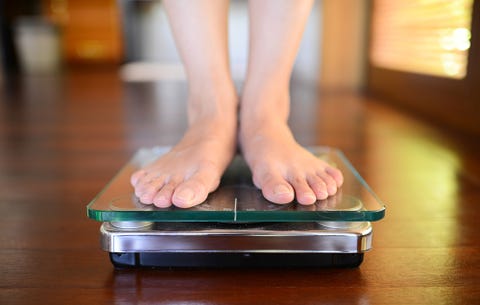
scale
  • You need to eat less. It doesn't matter if all you eat is grilled chicken, brown rice, and broccoli. If you don't cut back on your portions, you won't lose weight. Everyone's calorie needs are different, but in general, a woman eating 2,000 calories per day should aim to cut back by 400 to 500 calories, recommends Frances Largeman-Roth, RDN, nutrition expert and author of Eating in Color.
  • You should aim to lose 1 to 2 pounds per week. Those drop-a-dress-size-in-a-week plans are tempting. But the slow and steady approach is more sustainable since you're more likely to build healthy habits (like exercising more and eating more veggies) that will help you stay leaner in the long term.
  • Skipping meals will mess with your metabolism. When you skip breakfast or dinner, it tells your body to squirrel away calories instead of burning them. Skipping meals also increases the chances that your blood sugar will crash, leaving you ravenous for a quick energy hit in the form of sugary carbs, Cederquist says.
  • Keeping your carbs in check—especially the refined kind—can help combat age-related insulin resistance and promote steady blood sugar levels, Cederquist says. Adding more protein to your diet can also help. Not only does the nutrient help stave off age-related muscle loss, but it also helps keep your metabolism revved, because the body has to work harder to digest it than, say, a bagel, Cederquist says. How much of each nutrient you consume each time you eat matters, too. In a perfect world each meal and snack should have:
  • Vegetables or fruit: Fill half of your plate with these. They’re high in fiber and water, so they'll take up lots of space in your stomach without contributing too many calories to your diet.
  • Lean protein: Your plate should have a serving that’s about the size of your palm. Good sources include Greek yogurt, eggs, chicken, and fish. 
  • Complex carbohydrates: Your plate should have a serving that’s the size of your closed fist. Whole grains, beans, fresh fruit, and starchy veggies (like sweet potatoes) are all good choices.
  • Healthy fats: These can add up quickly when you're trying to lose weight, so it's worth measuring your fats. Aim for 7 to 10 grams every time you eat. That’s 1½ tsp of olive oil, a quarter of an avocado, or two tablespoons of nuts or seeds.


Source:prevention.com/weight-loss/a20465042/lose-weight-over-40/

Friday, 8 December 2017

Should You Exercise If You Have A Cold?

Colds are more common in winter, but you don't necessarily have to stop exercising if you're feeling under the weather. According to Dr Keith Hopcroft, a GP from Basildon in Essex, use common sense and listen to your body.
"If your symptoms are not severe and you generally feel OK, then you can exercise. If you feel absolutely rotten, then it's best not to go."
However, it is important not to exercise if you have a fever. A fever is when your body's temperature is 38C (100.4F) or above and is rarely a symptom of a cold.
"If you exercise with a fever," says Dr Hopcroft, "it'll make you feel worse. In very rare cases, exercising with a fever can lead to the virus affecting your heart, which can be dangerous."
If you have asthma, take extra care when exercising in winter as cold air can trigger symptoms. Use your inhaler before you exercise and have it with you during your activity.
Keep Warm
If you're starting a new exercise regime, don't overdo it. Slowly build the amount of exercise you do. If you can't manage 30 minutes in one go, break it up into 10-minute chunks.
Always warm-up for up to 10 minutes before you start. Walk at a brisk pace, or jog to warm your muscles.
Make sure you're warm if you're going outside. Wear several layers to keep the heat in. A lot of heat escapes through your head, so consider wearing a hat as well.

Image result for having a cold


Source:nhs.uk/Livewell/fitness/pages/winterexercise.aspx

Monday, 3 April 2017

Swim Your Way to Health

Every type of exercise has its selling points. But swimming is unlike any other aerobic workout in a few important ways.

First, the fact that you’re submerged in water means your bones and muscles are somewhat unshackled from the constraints of gravity, says Hirofumi Tanaka, a professor of kinesiology and director of the Cardiovascular Aging Research Lab at the University of Texas.

This makes swimming the ideal exercise for people with osteoarthritis, for whom weight-bearing exercise can be excruciatingly painful. According to Tanaka's research of people with the condition, swimming decreases arterial stiffness, a risk factor for heart trouble. More of his research has linked swim training with lower blood pressure among people with hypertension. The coolness and buoyancy of water are also appealing to people who are overweight or obese, for whom load-bearing aerobic exercises like running may be too hot or uncomfortable, Tanaka says.

Image result for swimming

But don't be fooled; your body is working hard when you’re in the pool. Water is denser than air, so moving through H2O puts more external pressure on your limbs than out-of-water training, studies have shown. Even better, that pressure is uniformly distributed. It doesn’t collect in your knees, hips or the other places that bear most of the burden when you exercise with gravity sitting on your shoulders.

How you breathe during a swimming workout is another big differentiator, says David Tanner, a research associate at Indiana University and co-editor of an educational handbook on the science of swimming. During a run or bike ride, your breath tends to be shallow and your exhales forceful. “It’s the other way around with swimming,” says Tanner. “You breathe in quickly and deeply, and then let the air trickle out.” Because your head is under water when you swim, these breathing adjustments are vital, and they may improve the strength of your respiratory muscles, Tanner says. “This kind of breathing keeps the lung alveoli”—the millions of little balloon-like structures that inflate and deflate as your breathe—“from collapsing and sticking together."

Plus, who wouldn't want a swimmer's body? Swimming fires up more of your body’s major muscle groups than other forms of cardio exercise. “If you think about running or biking, you’re mostly using your lower body,” Tanner says. Swimming not only engages your legs, but also recruits your upper body and core—especially your lats, the muscles of your middle back, and triceps, the backs of your upper arms. “You look at pictures of swimmers, and you see how the upper body development is really tremendous," he says.

Finally, your back benefits. Working out in a horizontal pose—as opposed to the upright position your body assumes during other forms of aerobic exercise—may be an ideal way to counteract all the time you spend hunched over a desk or steering wheel. “There’s no hard impact on your back like there is with running, and instead of being bent forward like you would be on a bike, your back tends to be arched slightly in the opposite direction,” Tanner says. That may help improve your posture and prevent the back injuries and pain that stem from long stretches of sedentary time.

The exercise is also linked to many of the same life-extending, heart-saving, mood-lifting benefits associated with other forms of aerobic exercise. And it's fun, which matters. “People tend to enjoy swimming more than running or bike-riding,” Tanaka says. While about half of people who try a new exercise program give up within a few months, people who take up swimming are more likely to stick with it, he says.

If you’re sold on swimming, Tanner recommends starting slowly. “Don’t try to do too much too early, and focus on proper technique,” he says. Consider enlisting the help of an instructor if you didn’t have any formal coaching as a kid. “If you’re not used to swimming, it can be hard to relax in the water,” he says. Being nervous and tight may limit the sport’s benefits.


Start off with 30-minute sessions three times a week, and don't forget to take frequent breaks. “You want to ease into it and build up," he says, "just like a running program."

Image result for swimming


Source:time.com/4688623/swimming-pool-health-benefits/

Saturday, 3 December 2016

Quick Ways To Fit In 10 Minutes Of Exercise

Breaking exercise into small chunks on your overscheduled days can also keep your confidence up, since skipping it altogether can make you feel tired, guilty, or depressed. Keep in mind, though, that short bursts of exercise are meant to supplement, not replace, your regular fitness routine.
Here are simple, practical ways to work exercise into your day even when you're short on time:
Around the House
1. When you go outside to pick up your morning newspaper, take a brisk 5-minute power walk up the street in one direction and back in the other. 
2. If you're housebound caring for a sick child or grandchild, hop on an exercise bike or do a treadmill workout while your ailing loved one naps.
3. Try 5 to 10 minutes of jumping jacks. (A 150-pound woman can burn 90 calories in one 10-minute session.)
4. Cooking dinner? Do standing push-ups while you wait for a pot to boil. Stand about an arm's length from the kitchen counter, and push your arms against the counter. Push in and out to get toned arms and shoulders.
5. After dinner, go outside and play tag or shoot baskets with your kids and their friends.
6. Just before bed or while you're giving yourself a facial at night, do a few repetitions of some dumbbell exercises, suggests exercise instructor Sheila Cluff, owner and founder of The Oaks at Ojai and The Palms, in Palm Springs, CA, who keeps a set of free weights on a shelf in front of her bathroom sink.

While Waiting

7. Walk around the block several times while you wait for your child to take a music lesson. As your fitness level improves, add 1-minute bursts of jogging to your walks.
8. Walk around medical buildings if you have a long wait for a doctor's appointment. "I always ask the receptionist to give me an idea of how long I have left to wait," Cluff says. "Most are usually very willing to tell you."
9. While your son or daughter plays a soccer game, walk around the field.
10. Turn a trip to a park with your child into a mini-workout for you. Throw a ball back and forth and run for fly balls. 

Friday, 18 November 2016

High Cholesterol

Cholesterol is a fatty substance known as a lipid and is vital for the normal functioning of the body. It's mainly made by the liver, but can also be found in some foods.

Having an excessively high level of lipids in your blood (hyperlipidemia) can have an effect on your health.
High cholesterol itself doesn't usually cause any symptoms, but it increases your risk of serious health conditions.

About cholesterol

Cholesterol is carried in your blood by proteins. When the two combine, they're called lipoproteins.
The two main types of lipoprotein are: 
  • high-density lipoprotein (HDL) – carries cholesterol away from the cells and back to the liver, where it's either broken down or passed out of the body as a waste product; for this reason, HDL is referred to as "good cholesterol", and higher levels are better
  • low-density lipoprotein (LDL) – carries cholesterol to the cells that need it, but if there's too much cholesterol for the cells to use, it can build up in the artery walls, leading to disease of the arteries; for this reason, LDL is known as "bad cholesterol"
The amount of cholesterol in the blood – both HDL and LDL – can be measured with a blood test.
The recommended cholesterol levels in the blood vary between those with a higher or lower risk of developing arterial disease.

Why should I lower my cholesterol?

Evidence strongly indicates that high cholesterol can increase the risk of:
  • narrowing of the arteries (atherosclerosis) 
  • heart attack 
  • stroke 
  • transient ischaemic attack (TIA) – often known as a "mini stroke"
  • peripheral arterial disease (PAD)
This is because cholesterol can build up in the artery wall, restricting the blood flow to your heart, brain and the rest of your body. It also increases the risk of a blood clot developing somewhere in your body.
Your risk of developing coronary heart disease also rises as your blood's cholesterol level increases. This can cause pain in your chest or arm during stress or physical activity (angina).

What causes high cholesterol?

Many factors can increase your chances of having heart problems or a stroke if you have high cholesterol.
These include:
  • an unhealthy diet – in particular, eating high levels of saturated fat
  • smoking – a chemical found in cigarettes called acrolein stops HDL transporting cholesterol from fatty deposits to the liver, leading to narrowing of the arteries (atherosclerosis)
  • having diabetes or high blood pressure (hypertension)
  • having a family history of stroke or heart disease
There's also an inherited condition called familial hypercholesterolaemia, which can cause high cholesterol even in someone who eats healthily.

When should my cholesterol levels be tested?

Your GP may recommend that you have your blood cholesterol levels tested if you:
  • have been diagnosed with coronary heart disease, stroke or mini stroke (TIA), or peripheral arterial disease (PAD)
  • have a family history of early cardiovascular disease
  • have a close family member who has a cholesterol-related condition
  • are overweight
  • have high blood pressure, diabetes, or a health condition that can increase cholesterol levels

What should my cholesterol levels be?

Blood cholesterol is measured in units called millimoles per litre of blood, often shortened to mmol/L.
As a general guide, total cholesterol levels should be:
  • 5mmol/L or less for healthy adults
  • 4mmol/L or less for those at high risk
As a general guide, LDL levels should be:
  • 3mmol/L or less for healthy adults
  • 2mmol/L or less for those at high risk
An ideal level of HDL is above 1mmol/L. A lower level of HDL can increase your risk of heart disease.
Your ratio of total cholesterol to HDL may also be calculated. This is your total cholesterol level divided by your HDL level. Generally, this ratio should be below four, as a higher ratio increases your risk of heart disease.
However, cholesterol is only one risk factor and the level at which specific treatment is required will depend on whether other risk factors, such as smoking and high blood pressure, are also present.

How can I lower my cholesterol level?

The first step in reducing your cholesterol is to maintain a healthy, balanced diet. It's important to keep your diet low in fatty food.
You can swap food containing saturated fat for fruit, vegetables and wholegrain cereals. This will also help prevent high cholesterol returning.
Other lifestyle changes, such as taking regular exercise and giving up smoking (if you smoke), can also make a big difference in helping to lower your cholesterol.
If these measures don't reduce your cholesterol and you continue to have a high risk of developing heart disease, your GP may prescribe a cholesterol-lowering medication, such as statins.
Your GP will take into account the risk of any side effects from statins, and the benefit of lowering your cholesterol must outweigh any risks.

Image result for cholesterol

The next post will be about diet and Cholesterol


Source:nhs.uk/conditions/Cholesterol/Pages/Introduction.aspx

Wednesday, 16 November 2016

What A Shock!!

Today's post is about what has happened in my life recently and how it has made me (and a lot of other shocked folk) think diffently about their lifestyle.

Just over a week ago my fit and healthy husband suffered a mild heart attack. Fortunately he is now on the mend with a stent fitted to open up his artery and medication for the rest of his life.

He has always been within a healthy weight and was a regular cyclist taking part in a yearly 70+ mile charity bike ride up some very tough hills (which he always cycled up without getting off his bike).

Now I am not so naive to know that heart problems can happen to anyone. Living a healthy lifestyle that he has, non smoker and the odd drink, I won't say hasn't made a difference. The difference is that the whole outcome could have been totally different and a lot worse.

I don't write this to scare anyone and the reason for his attack has possibly been down to a slightly raised cholesterol and according to the hospital 'bad genes/family history'.

As an active family and I would say reasonably good diet, we have been partial to a piece of cake and the odd ale. I'm very much a believer in a little bit of what you fancy. However, I have now taken a long hard look at any little tweeks and changes I can add to our diet/lifestyle to keep it tip top.

So, the next however many posts will be dedicated to any findings, tips and advice I can share with you along the way. These will hopefully help you also in taking a look at your own lifestyle and seeing if I can help you too :)


Image result for heart health

Friday, 16 September 2016

7 Ways Sleep Boosts Your Health

Here are seven ways in which a good night's sleep can boost your health:

1. Sleep boosts immunity

If you seem to catch every cold and flu that’s going around, your bedtime could be to blame. Prolonged lack of sleep can disrupt your immune system, so you’re less able to fend off bugs.

2. Sleep can slim you

Sleeping less may mean you put on weight! Studies have shown that people who sleep less than seven hours a day tend to gain more weight and have a higher risk of becoming obese than those who get seven hours of slumber.
It’s believed to be because sleep-deprived people have reduced levels of leptin (the chemical that makes you feel full) and increased levels of ghrelin (the hunger-stimulating hormone).

3. Sleep boosts mental wellbeing

Given that a single sleepless night can make you irritable and moody the following day, it’s not surprising that chronic sleep debt may lead to long-term mood disorders like depression and anxiety.
When people with anxiety or depression were surveyed to calculate their sleeping habits, it turned out that most of them slept for less than six hours a night.

4. Sleep prevents diabetes

Studies have suggested that people who usually sleep less than five hours a night have an increased risk of having or developing diabetes.
It seems that missing out on deep sleep may lead to type 2 diabetes by changing the way the body processes glucose – the high-energy carbohydrate that cells use for fuel.

5. Sleep increases sex drive

Men and women who don’t get enough quality sleep have lower libidos and less of an interest in sex, research shows.
Men who suffer from sleep apnoea – a disorder in which breathing difficulties lead to interrupted sleep – also tend to have lower testosterone levels, which can lower libido.

6. Sleep wards off heart disease

Long-standing sleep deprivation seems to be associated with increased heart rate, an increase in blood pressure and higher levels of certain chemicals linked with inflammation, which may put extra strain on your heart.

7. Sleep increases fertility

Difficulty conceiving a baby has been claimed as one of the effects of sleep deprivation, in both men and women. Apparently, regular sleep disruptions can cause trouble conceiving by reducing the secretion of reproductive hormones.

Image result for sleep


Source:nhs.uk/Livewell/tiredness-and-fatigue/Pages/lack-of-sleep-health-risks.aspx


Wednesday, 14 September 2016

Juices, smoothies and 5 A DAY

Fruit and vegetable juices and smoothies contain a variety of vitamins that are good for our health. A small glass of fruit juice counts as one of your recommended five daily portions of fruit and vegetables.
But a glass of juice should only ever be one of your portions of 5 A DAY because it doesn't contain the fibre found in whole fruits and vegetables. Have other types of fruit and vegetables for the other four (or more) portions.
Fruit juice also contains sugar that can damage teeth. It's best to drink it with a meal because this can help protect teeth. The sugars found naturally in whole fruit are less likely to cause tooth decay because the sugar is contained within the structure of the fruit.
Image result for smoothies

When fruit is juiced or blended, the sugars are released. Once released, these sugars can damage teeth, especially if you drink juice frequently. Even unsweetened fruit juice is sugary, so keep an eye on the amount of fruit juice and smoothies you consume.
The government's current advice is to limit consumption of fruit/vegetable juices and smoothies to a combined total of 150ml a day.


Source:nhs.uk/Livewell/Goodfood/Pages/water-drinks.aspx
 
Blogger Templates