Pages

Subscribe:

Ads 468x60px

Wednesday, 29 August 2018

Things You Must Do To Lose Weight Over 40

With age comes many things: greater wisdom; deeper empathy; a greater sense of knowing who you are; and less happily, the very real possibility of a bigger pants size.
Starting in your 40s, it's easier than ever for the pounds to creep on—and tougher to take them off. Thanks to a slowing metabolism you could be burning 300 fewer calories per day than you did in your early 20s, according to the American Council on Exercise. What's more, falling estrogen levels during perimenopause and menopause (which begin in your early 40s) can cause insulin sensitivity, which makes it harder for your body to control the amount of sugar in your blood, says Caroline Cederquist, MD, a board-certified bariatric surgeon and founder of the meal delivery service BistroMD. This can make your blood sugar levels more prone to spiking and crashing, which can increase your urge to snack—especially on high-carb, sugary junk, Cederquist says.
Put it together, and it's no wonder so many women over 40 end up hitting a weight loss wall. But it doesn't have to be that way. With a few smart moves, you can outsmart your slowing metabolism and get lean—for good.
Sure, some things change after 40. But the basic tenets of successful weight loss stay the same, no matter how old you are. Before you take steps to ageproof your diet plan, it's a good idea to brush up on the basics.
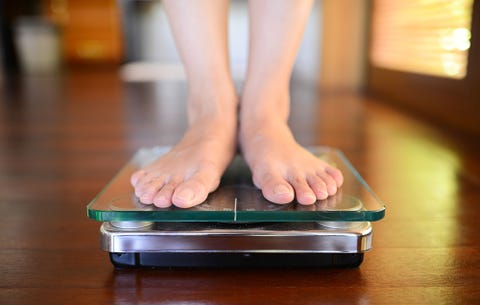
scale
  • You need to eat less. It doesn't matter if all you eat is grilled chicken, brown rice, and broccoli. If you don't cut back on your portions, you won't lose weight. Everyone's calorie needs are different, but in general, a woman eating 2,000 calories per day should aim to cut back by 400 to 500 calories, recommends Frances Largeman-Roth, RDN, nutrition expert and author of Eating in Color.
  • You should aim to lose 1 to 2 pounds per week. Those drop-a-dress-size-in-a-week plans are tempting. But the slow and steady approach is more sustainable since you're more likely to build healthy habits (like exercising more and eating more veggies) that will help you stay leaner in the long term.
  • Skipping meals will mess with your metabolism. When you skip breakfast or dinner, it tells your body to squirrel away calories instead of burning them. Skipping meals also increases the chances that your blood sugar will crash, leaving you ravenous for a quick energy hit in the form of sugary carbs, Cederquist says.
  • Keeping your carbs in check—especially the refined kind—can help combat age-related insulin resistance and promote steady blood sugar levels, Cederquist says. Adding more protein to your diet can also help. Not only does the nutrient help stave off age-related muscle loss, but it also helps keep your metabolism revved, because the body has to work harder to digest it than, say, a bagel, Cederquist says. How much of each nutrient you consume each time you eat matters, too. In a perfect world each meal and snack should have:
  • Vegetables or fruit: Fill half of your plate with these. They’re high in fiber and water, so they'll take up lots of space in your stomach without contributing too many calories to your diet.
  • Lean protein: Your plate should have a serving that’s about the size of your palm. Good sources include Greek yogurt, eggs, chicken, and fish. 
  • Complex carbohydrates: Your plate should have a serving that’s the size of your closed fist. Whole grains, beans, fresh fruit, and starchy veggies (like sweet potatoes) are all good choices.
  • Healthy fats: These can add up quickly when you're trying to lose weight, so it's worth measuring your fats. Aim for 7 to 10 grams every time you eat. That’s 1½ tsp of olive oil, a quarter of an avocado, or two tablespoons of nuts or seeds.


Source:prevention.com/weight-loss/a20465042/lose-weight-over-40/

Tuesday, 28 August 2018

Preventative Health Habits Over 40

In your fabulous 40s, you still feel invincible—these are great years, after all.
But subtle changes are occurring that need to be addressed before they become problems. Here are some of the most common health shifts women experience: 
  • Metabolism: Slowing by 2% per decade.
  • Muscle: Down by 6 to 7 pounds from 10 years ago.
  • Bone: Dropping by about 1% a year since your mid-30s.
  • Libido: Declining because of high stress levels and hormonal changes.
  • Stress: Especially high because of worries about kids, parents, health, career, and finances.
  • Depression: More likely now than later in life.
Establish the following preventative habits now and you'll not only counter these changes—you'll stay healthier, sharper, more energetic, and more fulfilled for years to come.
Eat breakfast every day
Nutritionists agree that eating breakfast is essential to keeping weight down and calorie-burning metabolism up. In one study, women who ate a big breakfast lost 21% of their body weight after 8 months, compared with 4.5% for women on a low-carb diet who made breakfast their smallest meal. The healthy-breakfast eaters continued losing over time even though they ate more total calories, while the low-carb group started regaining weight after 4 months. 
Reason: A solid meal at the start of the day works in concert with metabolism, which is highest in the morning, fueling activity and preventing cravings that arise when blood sugar drops
Jump-start your metabolism
Strength-training for 6 months can increase your resting metabolism (a study on men showed a boost of 7%), so you’ll burn more calories even when you’re sitting on the sofa. 
Bonus: Strength-training also helps you shore up bone, maintain balance, and avoid injury—important for protecting your skeleton both now and when you’re older. Aim to exercise at least 30 minutes most days of the week.
Boost calcium and vitamin D
Both are essential for strong bones, but many experts feel current benchmarks are too low. The National Osteoporosis Foundation recommends that women in their 40s get 1,000 mg of calcium and 400 to 800 IU of vitamin D every day from foods like fortified milk or salmon, along with supplements if needed. Some nutrition experts suggest getting up to 1,000 IU a day for optimal health
4. Practice stress control
A healthy, calm heart beats faster when you breathe in, slower when you breathe out. But stress inhibits this natural "heart rate variability," triggering unhealthy changes bodywide, including increased blood pressure, less energy to the brain, lower libido, and faster cell death. "In effect, stress makes you age faster," says Claire Michaels Wheeler, MD, PhD, author of 10 Simple Solutions to Stress.
To get your heart into a healthier rhythm, breathe in through your nose for 4 beats and out for 8 at least twice a day or anytime you feel pressure. "That activates the vagus nerve that runs from the brain to the pelvis, relaxing the heart, muscles, airways, gastrointestinal tract, and blood vessels," says Dr. Wheeler.
Pump up protein
Getting foods with all the amino acids needed to form complete proteins at least twice a day boosts levels of mood-lifting neurotransmitters in the brain, which can help relieve symptoms of depression, like slow thinking and poor memory. Aim for 4 ounces of protein at each meal. Good sources include fish, eggs, and quinoa. But don’t totally skip carbs: They boost mood by increasing production of serotonin in the brain.
Go out with your girlfriends
Relaxing with friends reduces stress, boosts self-esteem, and even makes you more loving toward your partner when you get home. "Women are terrific at connecting socially but often let it fall by the wayside in their 40s because of career and family demands," says Edward Schneider, MD, emeritus dean and professor of gerontology and medicine at the University of Southern California’s Andrus Gerontology Center. Women with extensive social networks through family, work, volunteer organizations, religious groups, or hobbies have lower blood pressure, less diabetes, reduced risk of heart disease, and half as many strokes as women who are less well connected.

image


Source:prevention.com/life/g20496315/8-things-every-woman-in-her-40s-should-do/?slide=9

Monday, 11 December 2017

Get Active For Mental Wellbeing

Being active is great for your physical health and fitness, and evidence shows that it can also improve your mental wellbeing.
We think that the mind and body are separate. But what you do with your body can have a powerful effect on your mental wellbeing.
Mental wellbeing means feeling good – both about yourself and about the world around you. It means being able to get on with life in the way you want.
Evidence shows that there is a link between being physically active and good mental wellbeing.
Being active doesn’t mean you need to spend hours in the gym, if that doesn't appeal to you. Find physical activities that you enjoy and think about how to fit more of them into your daily life.

How exercise helps your mental wellbeing 

Scientists think that physical activity helps maintain and improve wellbeing in a number of ways.
Physical activity can help people with mild depression. Evidence shows that it can also help protect people against anxiety.
Physical activity is thought to cause chemical changes in the brain, which can help to positively change our mood.
Some scientists think that being active can improve wellbeing because it brings about a sense of greater self-esteem, self-control and the ability to rise to a challenge.

Image result for mental wellbeing


Source:nhs.uk/Conditions/stress-anxiety-depression/Pages/mental-benefits-of-exercise.aspx

Friday, 8 December 2017

Should You Exercise If You Have A Cold?

Colds are more common in winter, but you don't necessarily have to stop exercising if you're feeling under the weather. According to Dr Keith Hopcroft, a GP from Basildon in Essex, use common sense and listen to your body.
"If your symptoms are not severe and you generally feel OK, then you can exercise. If you feel absolutely rotten, then it's best not to go."
However, it is important not to exercise if you have a fever. A fever is when your body's temperature is 38C (100.4F) or above and is rarely a symptom of a cold.
"If you exercise with a fever," says Dr Hopcroft, "it'll make you feel worse. In very rare cases, exercising with a fever can lead to the virus affecting your heart, which can be dangerous."
If you have asthma, take extra care when exercising in winter as cold air can trigger symptoms. Use your inhaler before you exercise and have it with you during your activity.
Keep Warm
If you're starting a new exercise regime, don't overdo it. Slowly build the amount of exercise you do. If you can't manage 30 minutes in one go, break it up into 10-minute chunks.
Always warm-up for up to 10 minutes before you start. Walk at a brisk pace, or jog to warm your muscles.
Make sure you're warm if you're going outside. Wear several layers to keep the heat in. A lot of heat escapes through your head, so consider wearing a hat as well.

Image result for having a cold


Source:nhs.uk/Livewell/fitness/pages/winterexercise.aspx
 
Blogger Templates